
There’s a growing correlation between oil and gold. Higher oil leads to higher bond yields, destabilising the dollar’s value. The debasement trade is back on.
“This is little doubt that the dollar’s purchasing power and credibility will be severely undermined, and that gold will therefore run higher with a significantly higher oil price. This change in sentiment could be sudden and dramatic.”
Paper bulls of gold and silver may be down in the dumps, but there’s a quiet evolution in progress. And this is now evident in the relationship between gold and oil over the last three months:
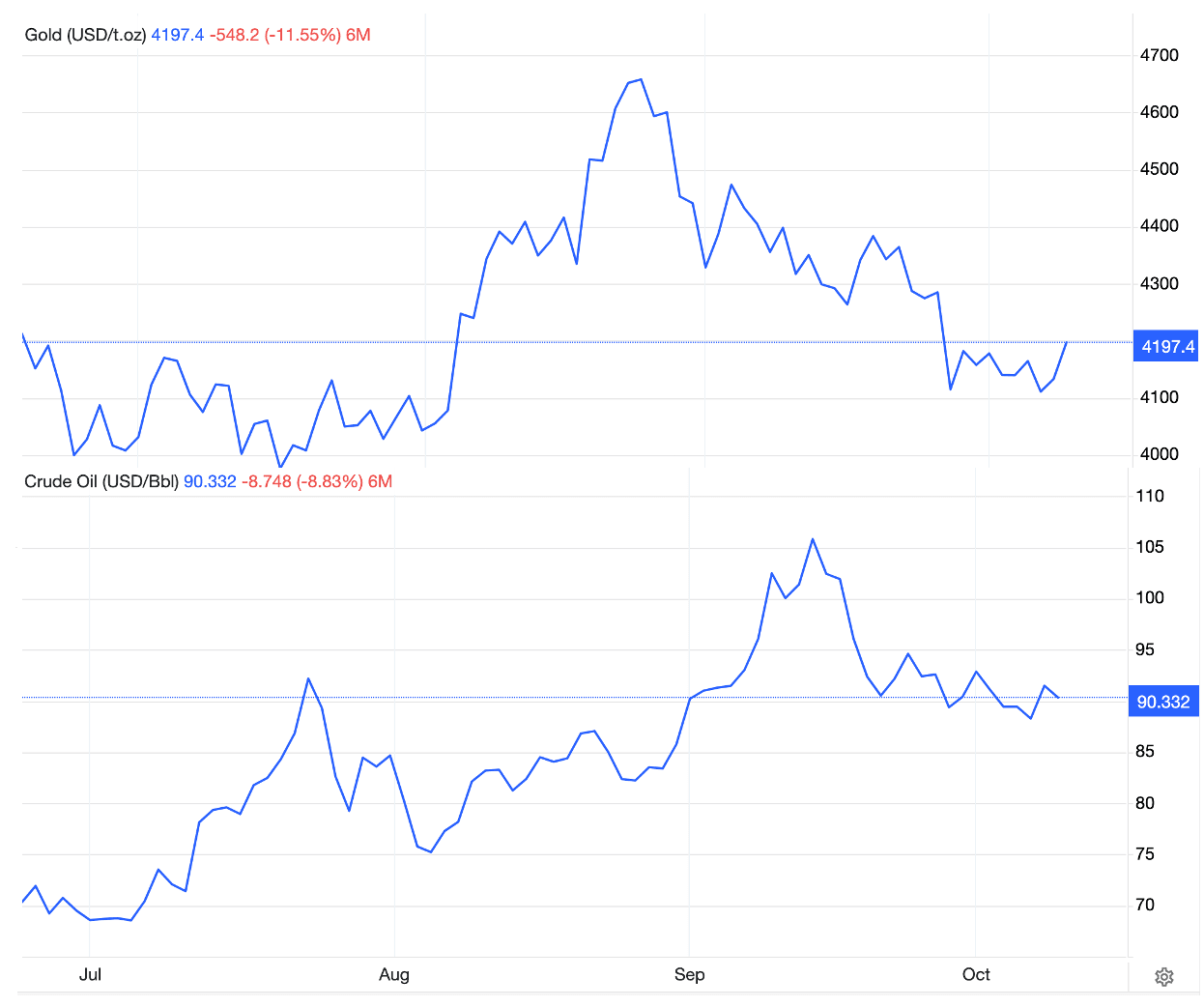
After oil’s peak last April, the price started a bottoming process in July, as did gold. Both then rose, not entirely synchronised, but roughly together with gold achieving its high point at end-August and oil three weeks later before both declined to recent lows in the last week.
This action questions the macro view which argues that higher oil prices lead to higher inflation and therefore interest rates, raising the cost of holding gold. But on examination this argument doesn’t hold water.
Why is this?
It’s a matter of perception about where risk ultimately lies and it’s here that macroeconomic analysis clashes with evolving facts. It is becoming clear that there is a conflict between US government funding requirements and the reluctance of foreign actors to buy US debt. This is leading to continuing Asian demand for gold, ignoring declines in the dollar price. And it is also becoming clear that with diesel, kerosene, and ship bunker shortages along with other oil derivatives that businesses face significantly higher costs and supply disruptions, leading to a slump in economic activity. At the same time, prices of virtually everything are being driven higher not just for businesses finding them difficult to pass on, but for consumers as well.
Higher oil prices guarantee the slump in economic activity, increasing the government’s budget deficit requiring it to bail out both failing businesses and markets. Bank credit will contract sharply, and the authorities will have no option but to replace it with a substantial expansion of base money, being the sum of currency and bank deposits on the Fed’s balance sheet.
This outcome is increasingly anticipated by foreign investors and the more prescient domestic institutions. The question now arises as to the outlook for oil. Will the hiatus in the Persian Gulf and the Red Sea end soon, or will it intensify?
The answer from two well informed sources, Professor Marandi in Tehran and Pepe Escobar is that during the UN General Assembly attended by both Iran’s President and Foreign Minister, Iran permitted an increase in traffic through Hormuz for diplomatic reasons. Their attendance was an opportunity for the Americans to reopen talks. Instead, it led to American claims that oil flows had returned to normal with WTI declining from $105 to $88.
Now that the UNGA is over and President Trump dismissed negotiations, Iran is now restricting traffic again and has taken to attacking shipping which either tries to evade the toll or is linked to non-friendly states. Coupled with an escalation of Houthi attacks on Saudi refineries and its East-West pipeline to Yanbu on the Red Sea, it is clear that oil shortages and their derivatives are about to intensify.
Spot prices are reportedly higher than one-month futures, which are in turn heavily backwardated driven by the 3-2-1 spread:
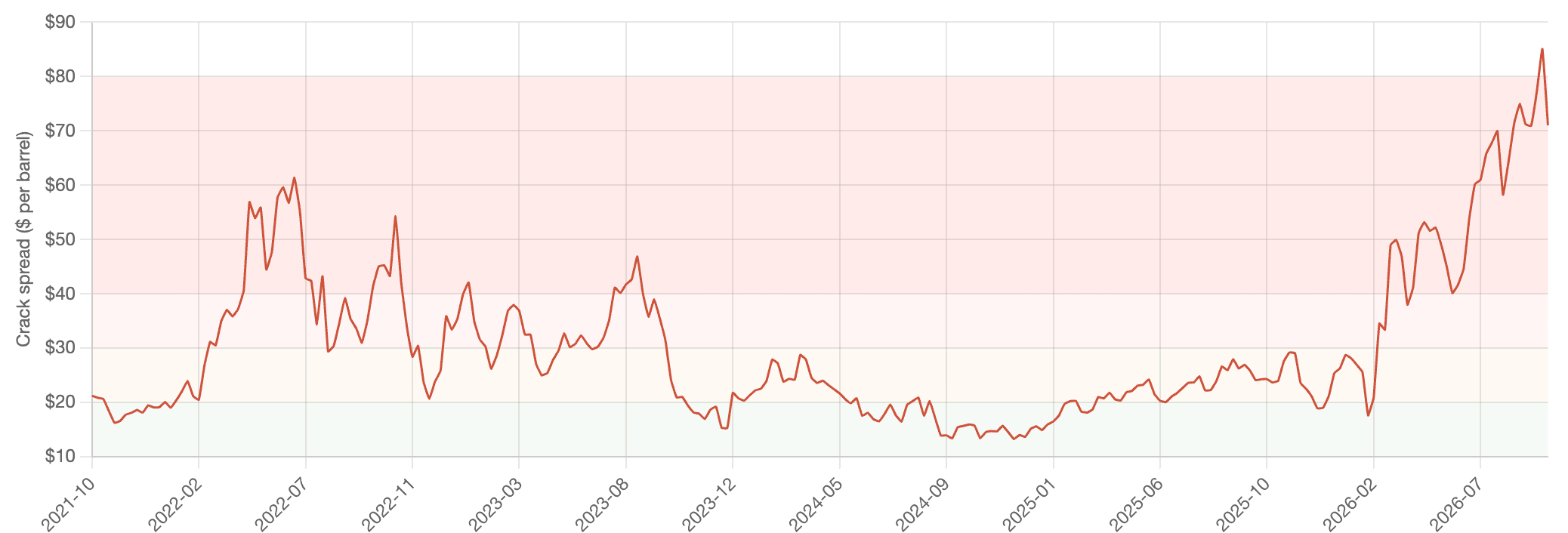
The spread is a measure of the value of diesel and petroleum extracted from a barrel of oil over the cost of the barrel. In other words, it is the refining margin, which in normal times is about $20. At $70+, it raises the price of a barrel. Coupled with renewed post-UN meeting restrictions on global supplies by Iran and the Houthis, we can see that the price of oil can only rise — and rapidly at that.
We can now see why gold is correlating with oil, and that higher oil prices will create an economic and funding crisis for the US government. This is little doubt that the dollar’s purchasing power and credibility will be severely undermined, and that gold will therefore run higher with a significantly higher oil price. This change in sentiment could be sudden and dramatic.